More than 60% of emerging infectious diseases in humans originate from animal reservoirs or animal-derived products. Each year, zoonotic diseases affect over two billion people worldwide, causing around two million deaths and generating economic losses running into the billions of dollars. The past decade alone has illustrated just how serious this threat can be: the global community has had to confront multiple internationally declared public health emergencies rooted in animal-to-human transmission, among them MERS, the Ebola outbreaks, and most recently the COVID-19 pandemic.
The accelerating pace of globalization, through increased movement of people, cross-border trade in animals, and international distribution of animal products, has further amplified the risk of pathogen spread. Human encroachment into natural habitats, driven by urbanization and agricultural expansion, is placing human populations in increasingly close contact with wildlife species that may harbor unknown or poorly studied pathogens. Climate change is adding another layer of complexity, as shifting ecosystems alter the geographic range of vectors and reservoir species alike.
Understanding the dynamics of animal reservoirs is therefore not merely an academic exercise but a public health imperative. Against this backdrop, the establishment of dedicated zoonotic disease biobanks has emerged as one of the most strategic responses available to the scientific and public health communities.
What Is a Zoonosis?
A zoonosis is a disease caused by a pathogen, virus, bacterium, parasite, or fungus, that can naturally be transmitted between animals and humans. Well-known examples include rabies, avian influenza, Ebola, Lyme disease, and certain coronaviruses such as SARS-CoV-2. It is estimated that there are currently more than 200 known zoonotic diseases, and new ones continue to be identified as surveillance and diagnostic capabilities improve.
Transmission is rarely straightforward. It involves a network of biological actors:
• Reservoir host: maintains the pathogen naturally, often without symptoms (e.g. bats for coronaviruses)
• Intermediate host: bridges the gap between the reservoir and human populations
• Amplifying host: accelerates pathogen replication, raising transmission risk
• Vector: carries the pathogen between hosts, mosquitoes, ticks, sandflies
• Accidental host (human): rarely drives transmission, but often bears the heaviest disease burden
Understanding the role of each actor in a given transmission chain is fundamental to designing effective prevention and surveillance strategies.
What Is a Zoonotic Biobank?
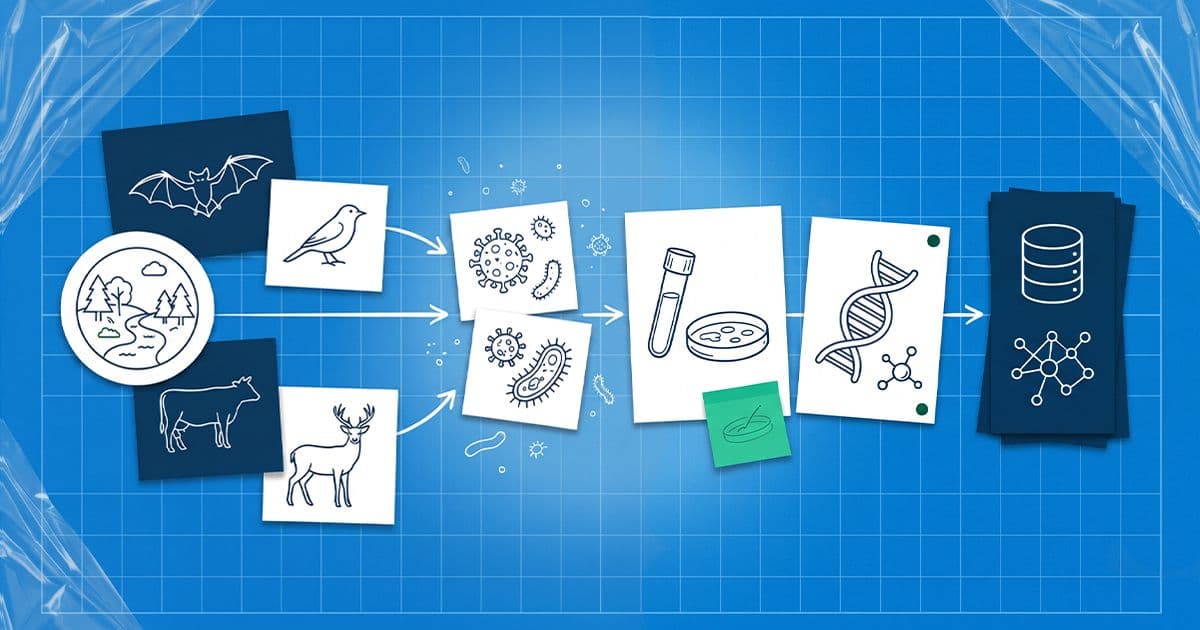
A zoonotic biobank collects, preserves, and analyzes biological samples from all actors involved in zoonotic transmission: wildlife, livestock, vectors, and environmental sources such as soil or water. What distinguishes it from a conventional biobank is the diversity of species and contexts it must handle.
Every sample is paired with detailed metadata: species, location, collection date, animal health status, and environmental conditions. Without this context, even the most advanced molecular analysis loses much of its value. Sample integrity matters just as much; proper storage and traceability are what transform a biobank into a long-term scientific resource rather than simply a frozen archive.
How Biobanks Strengthen Risk Assessment
The true power of a zoonotic biobank lies in its ability to shift disease management from reactive response to proactive, evidence-based surveillance. Rather than waiting for an outbreak to occur, biobanks allow scientists and public health officials to continuously monitor pathogen circulation and detect warning signs before they escalate.
Their core contributions to zoonotic risk assessment span five interconnected functions:
• Early pathogen detection: advanced molecular tools including PCR, whole-genome sequencing, and metagenomic analysis enable the identification of both known and previously undescribed pathogens in animal populations, often well before any human case is reported.
• Reservoir and transmission chain mapping: systematic cross-species sample analysis helps researchers identify which animal populations harbor specific pathogens and reconstruct the full chain of interspecies transmission.
• Pathogen evolution monitoring: longitudinal sample collections allow scientists to track mutations, recombination events, and host adaptations over time, providing early warning of changes in virulence or transmissibility.
• High-risk area identification: integrating biological, ecological, and climate data makes it possible to map geographic zones and environmental conditions most conducive to zoonotic spillover events.
• Public health decision support: robust biobank data supports risk assessment, guides the allocation of surveillance resources, and informs targeted prevention and response strategies.
The earlier a potential threat is identified, the more effective and cost-efficient the public health response becomes. Biobanks provide the infrastructure that enables systematic early detection at both national and international scales.
The One Health Approach
Zoonotic biobanks sit at the heart of the One Health framework, recognizing that human, animal, and environmental health cannot be managed in silos. By integrating data from animal surveillance, environmental monitoring, and human clinical systems, they allow researchers to connect signals that would otherwise go unnoticed: a new virus strain in migratory birds, a shifting vector range, or a cluster of unexplained fevers. Together, these signals can reveal an emerging threat in time to act.
Building this capacity comes with real obstacles: biosafety constraints, cold-chain costs, cross-border data governance, and infrastructure gaps in lower-income countries. Overcoming these challenges is not simply about ambition; it is essential for preparedness.
Zoonotic disease biobanks are no longer optional infrastructure; they are a fundamental pillar of modern public health preparedness. By systematically collecting, preserving, and analyzing biological samples from animal populations over time, they provide the scientific community with a longitudinal view of pathogen circulation and evolution that no other tool can replicate.
They support early detection, enable a deeper understanding of transmission dynamics, and strengthen the evidence base for prevention and response strategies. In an era defined by increasing ecological disruption and accelerating global connectivity, their role as an early warning system will only become more vital.
In a world where the next pandemic may already be circulating silently within an animal reservoir, zoonotic biobanks represent one of our most powerful tools for detecting, understanding, and stopping future health threats before they reach human populations.