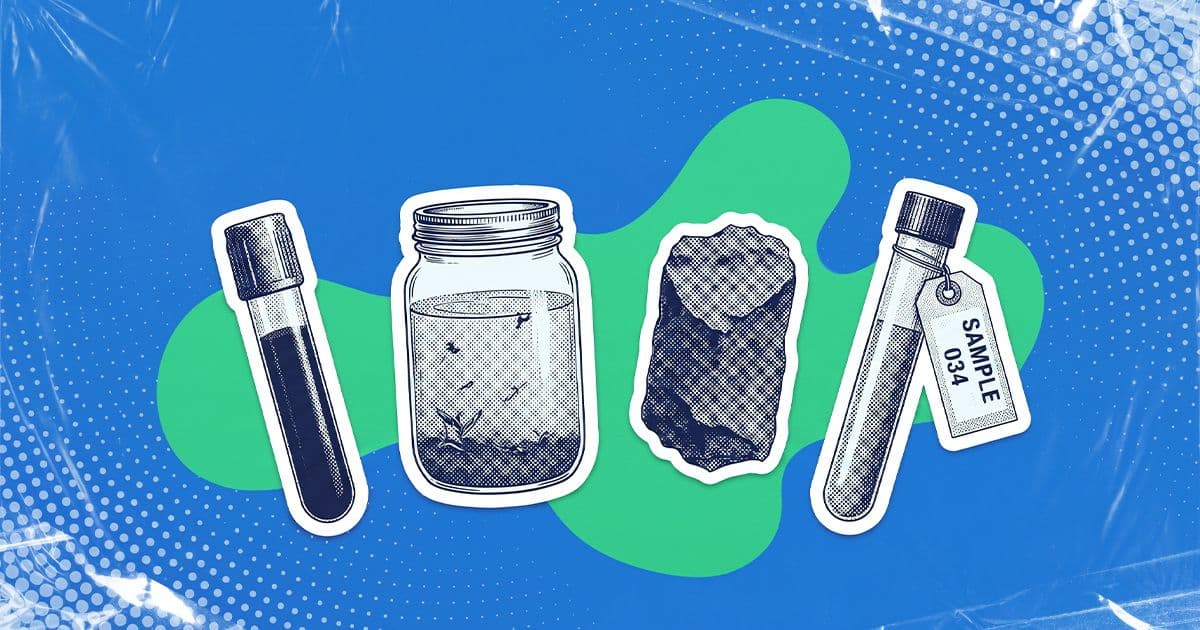
The previous chapter ended with an image of scale: expeditions returning with tens of thousands of specimens, hospitals generating samples week after week, collections growing faster than any single institution could comfortably absorb. But the growth was not only a matter of quantity. As laboratories expanded and scientific inquiry pushed into new territories, something else became apparent.
The samples themselves were not all the same kind of thing.
This might seem obvious in retrospect. Of course a vial of blood is not the same as a jar of river water, not the same as a fragment of ore, not the same as a culture taken from a patient's wound. But for a long time, the differences between these objects were treated as secondary details, variations on a single underlying practice. What the nineteenth century gradually revealed is that they were not. Each category of sample carried its own logic, its own relationship to the world it came from, and its own set of demands on the people who worked with it.
Understanding that diversity, not just accommodating it, is where modern sample science begins.
The biological sample: a fragment that was once alive
The oldest category, and in many ways the most complex, is the biological sample. Blood, urine, tissue, bone, preserved organisms, cultivated cells: what unites them is that they come from living systems, or from things that once lived.
This origin is what makes them distinctive. A biological sample is not a stable object. It is a fragment of a process that was ongoing at the moment of collection. Enzymes continue to act after extraction. Cells continue to change. Proteins unfold. Genetic material degrades. The act of separating a biological sample from its source does not freeze it in time, it simply removes it from the conditions that were sustaining it, and sets a different clock in motion.
This means that a biological sample is always, in a precise sense, a record of a moment rather than a permanent object. What it contains at collection is not necessarily what it will contain an hour later, or a week later. Its value is inseparable from its relationship to time.
The environmental sample: a window into a system in motion
A different kind of complexity emerges with environmental samples: water drawn from a river, air captured above an industrial site, soil taken from a contaminated field, sediment lifted from a lake bed.
What defines this category is not the biological activity of the sample itself, but the nature of what it represents. An environmental sample does not come from an individual. It comes from a system, and systems are not static. A river changes between morning and afternoon. Soil composition shifts across a few meters of ground. Air quality fluctuates with wind direction and temperature.
This raises a question that the biological sample does not pose in quite the same way: where, exactly, do you collect? And when? And how many times? A single water sample from one point along a river tells you something, but how much can it really tell you about the river as a whole? The problem of representativeness, which ancient grain merchants solved through intuition and experienced judgment, returns here with a new intensity.
The environmental sample forced a rethinking of what a sample is supposed to represent, and whether a single fragment can ever speak reliably for a whole that is constantly moving.
The geological and material sample: reading deep time
Alongside biological and environmental samples, a third category developed through the expansion of geology, mineralogy, and later industrial chemistry: the material sample. Rock cores, mineral fragments, sediment layers, ores, and eventually manufactured substances subjected to quality control.
What distinguishes this category is its relationship to time, but in a direction opposite to that of the biological sample. Where a biological sample races toward degradation from the moment of collection, a geological sample is, in most cases, extraordinarily stable. A piece of rock extracted from a cliff face will look much the same in a century as it does today.
The challenge here is not preservation but interpretation. A rock does not announce its history. It encodes it, in layers, in isotope ratios, in crystal structures that require specific instruments and methods to decode. The material sample is less a fragment of a living process than an archive of an ancient one, and reading it demands a different set of questions entirely.
The clinical sample: where science meets the individual
With the formalization of medicine in the nineteenth century, a fourth category crystallized: the clinical sample. Biologically, it overlaps with biological samples in general. But its defining characteristic is not material, it is relational. A clinical sample belongs to a person.
This transforms the nature of the object. A clinical sample is not just a physical fragment to be analyzed. It is evidence about a specific individual at a specific moment in their health history. Its scientific value and its human meaning are inseparable in a way that does not apply to a water sample or a mineral core.
This category introduced a dimension that the others did not carry in the same way: the sample as something that can matter profoundly to the person from whom it came, and whose identity must remain attached to it through every stage of handling, analysis, and storage.
What the diversity reveals
Laid out side by side, these categories share a surface resemblance. They are all, in some sense, fragments separated from a larger whole for the purpose of study. The basic gesture is the same one a Mesopotamian farmer made when he pressed soil between his fingers.
But the nature of what is being captured, the relationship between the fragment and the whole it represents, the kind of information it carries, and the conditions under which that information remains valid, differ fundamentally across these types. A river and a patient and a lakebed and a rock formation are not the same kind of whole. The fragments taken from them are not the same kind of object, even when they sit side by side in the same storage room.
Recognizing this was not just an academic refinement. It had direct practical consequences. Because if samples are genuinely different in nature, it follows that they cannot all be approached in the same way.
That is where our next chapter begins.