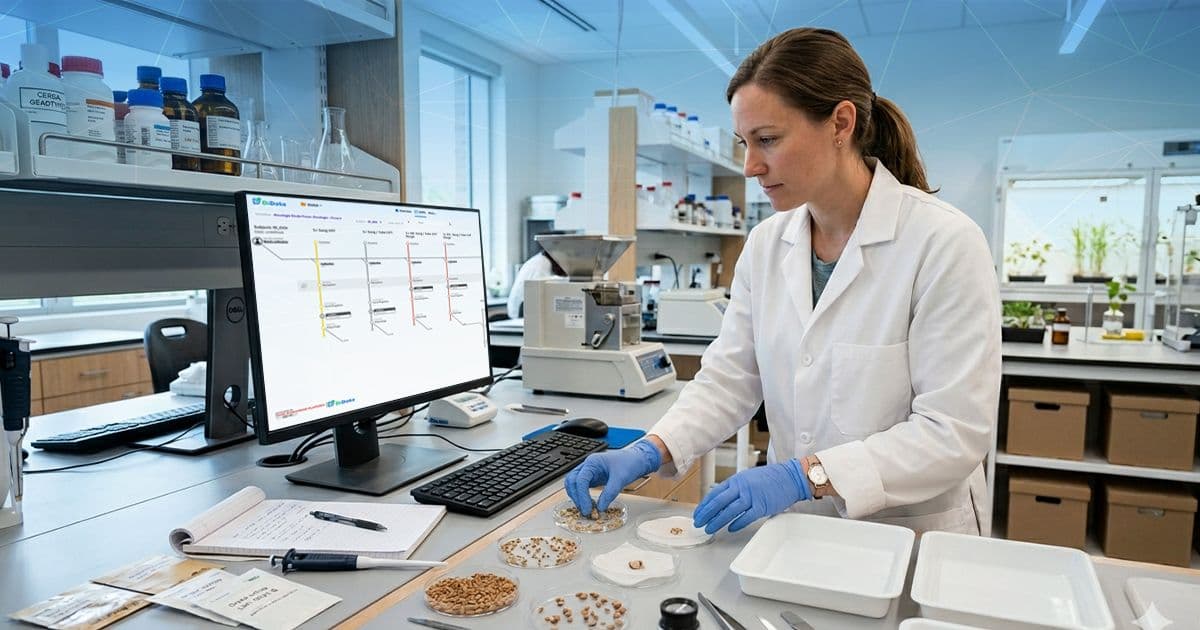
From Traditional Conservation to Intelligent Data Management
For millennia, seeds have been at the core of agriculture and human survival. Long before the emergence of modern gene banks, farmers selected, preserved, and exchanged seeds adapted to their local environments.
In the 20th century, faced with biodiversity loss and the industrialization of agriculture, a new mission emerged: the systematic preservation of plant genetic resources. This led to the creation of seed banks true living archives of the world’s plant heritage.
Today, these institutions play a strategic role in food security, scientific research, and climate change adaptation. However, preserving a seed is not simply about storing it.
Understanding the Seed: A Living Organism
A seed is not an inert object. It is a living organism in a dormant state, whose balance is fragile and evolves over time.
Even under optimal storage conditions, a seed gradually loses its ability to germinate. This process, often invisible in the short term, requires careful monitoring to prevent the loss of valuable genetic resources.
Two key indicators are central to this understanding:
Viability, which refers to a seed’s ability to remain alive over time, and the germination rate, which measures the proportion of seeds capable of producing a seedling under given conditions.
These parameters are essential for monitoring collection health, planning regeneration cycles, and ensuring the quality of conserved and distributed seeds.
Historically Manual Practices
For a long time, seed management relied on simple and well-established methods: laboratory notebooks, paper records, direct observations, and more recently, standalone spreadsheets.
These practices have enabled the development of invaluable collections and are still in use in many institutions today.
However, as collections have expanded, the number of samples has increased, and germination testing has become more frequent, the volume of data to manage has grown significantly. In this context, traditional methods are gradually reaching their limits, making monitoring, analysis, and data utilization increasingly complex.
The Turning Point: Data Complexity
Today, seed banks manage not only biological samples but also a large volume of associated scientific data.
This data encompasses multiple dimensions: germination histories, storage conditions, experimental protocols, variations between batches, and long-term observations.
Such complexity makes data exploitation more challenging and introduces several issues, including fragmented information, lack of standardization, difficulties in long-term analysis, and reduced traceability.
The question is no longer only how to preserve seeds, but how to effectively use the data that allows us to understand them.
Digitalization as a Natural Evolution
In response to these challenges, digitalization has emerged as a natural evolution of scientific practices. It does not represent a disruption, but rather a continuation enabling the structuring and connection of previously fragmented information.
It allows for data centralization, organization according to consistent standards, and easier access and sharing among teams.
However, this transformation goes beyond the introduction of digital tools. It also involves evolving workflows, standardizing protocols, and, in some cases, integrating equipment that enhances data collection and reliability.
Gradually, this approach enables a shift from descriptive management to a more analytical one, providing deeper insights into biological dynamics and supporting better anticipation of future changes.
The Didata Approach: Structuring, Centralizing, Enhancing
In this evolving context, where data volumes continue to grow and practices become more complex, the challenge for plant genetic resource banks is no longer just to store information, but to give it meaning over time.
This is precisely where the solutions developed by Didata come into play.
By adopting a data-centric approach, Didata provides tools that help structure heterogeneous information collected over long periods and across diverse protocols. This structuring is essential to ensure scientific consistency and facilitate the interpretation of results.
In addition, centralizing data within a unified environment helps overcome the limitations of fragmented systems. It provides a continuous view of seed lots, making it possible to monitor viability and germination behavior more accurately over time.
This continuity not only improves the traceability of experiments but also enhances the understanding of biological dynamics across species and storage conditions.
In this context, data is no longer just a historical record. It becomes a powerful analytical tool that supports decision-making, particularly in regeneration planning and collection quality assessment.
By improving access to, readability of, and interpretation of data, Didata contributes to greater operational efficiency while supporting the scientific rigor required in genetic resource management.
An Evolution in Continuity
The history of seed banks reflects a constant ability to adapt to agricultural, environmental, and scientific challenges. While their fundamental mission preserving plant diversity remains unchanged, the methods used to achieve it continue to evolve.
Today, seed management can no longer be separated from the management of the data associated with it. Understanding viability trends, analyzing germination rates, and anticipating regeneration needs all require a more structured and comprehensive approach.
Digitalization thus emerges as a natural extension of traditional practices, providing tools that connect observation, measurement, and analysis in a coherent and continuous framework.
Within this perspective, Didata supports this transition by offering solutions that transform complex data into actionable insights, serving research, conservation, and the valorization of plant genetic resources.
Preserving a seed also means preserving and understanding the data that tells its story over time.