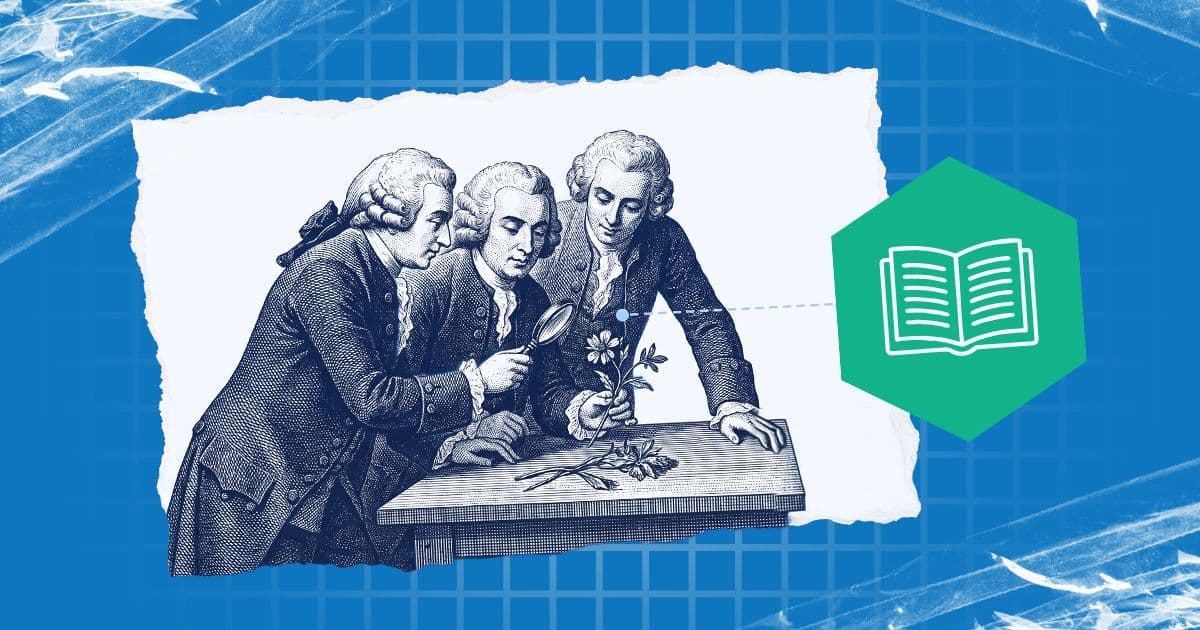
We ended our last chapter on a fragile note. Naturalists had learned to examine samples closely, to name them with precision, to keep them in ordered cabinets. But all of this still depended on one person's memory, one person's notes, one person's judgment. A single life, however careful, was a thin thread on which to hang an entire body of knowledge.
The eighteenth century did not solve this problem by making individuals more careful. It solved it by changing where knowledge lived.
The Birth of Scientific Collaboration
In 1660, a group of natural philosophers in London began meeting regularly to discuss experiments, compare specimens, and, crucially, watch each other work. Within two years, this informal gathering became the Royal Society. A few years later, in Paris, the Académie des sciences was founded on a similar premise. Across Europe, learned societies multiplied, each built around the same simple but radical idea: knowledge should not rest on the word of one observer, it should be tested in front of others.
This changed the status of the sample itself. A specimen examined in private was, ultimately, a private claim. The same specimen examined in a shared space, in front of colleagues who could question the method, repeat the observation, or propose an alternative explanation, became something closer to public evidence.
The cabinet had been a place to keep things. The laboratory, in this new sense, was a place to contest them.
The Value of How, Not Just What
This shift toward shared scrutiny created a new demand: if others were going to repeat your work, you had to describe exactly how you had done it. Francis Bacon had already argued, decades earlier, that knowledge should be built from systematic experiment rather than authority or speculation. Now this idea acquired teeth.
A finding was no longer simply announced, it came with a method attached: how the sample was obtained, how it was prepared, what conditions surrounded the observation. This is a quiet but decisive turning point. The object of interest was no longer only the sample, but the sequence of steps that connected the sample to the conclusion drawn from it.
For the first time, the process became as important as the specimen.
The Birth of Scientific Specialization
As scientific work scaled beyond what a single naturalist could manage, something else changed: the tasks themselves began to separate. Expeditions employed dedicated collectors, who gathered specimens in the field but did not necessarily analyze them. Institutions employed curators, whose job was to preserve, catalogue, and maintain collections, distinct from the scholars who studied them. Correspondence networks relied on intermediaries who simply moved specimens and information between distant collectors.
This division of labor, collecting, analyzing, preserving, looks unremarkable today. But it represents a genuine reorganization of scientific work. Where the eighteenth-century naturalist had once done everything alone, by the early nineteenth century these functions had begun to live in different hands, sometimes in different buildings entirely.
The First Traceability Systems
With more people touching the same specimens, a new kind of document became indispensable: the register. Natural history museums and botanical gardens, expanding rapidly in this period, began keeping detailed catalogues, listing what had been collected, by whom, when, and where it was now stored.
This was a modest innovation in appearance, a ledger, a numbered sequence, a few columns of handwriting. But its function was significant. It meant that the history of a specimen no longer lived solely in someone's memory or correspondence. It lived in a document that could outlast any single contributor, be consulted by someone who had never met the original collector, and be corrected or expanded over time.
This is, in essence, the direct ancestor of the laboratory notebook, and eventually, of the structured digital records that laboratories rely on today.
The Limits of Early Organization
By the early nineteenth century, science had built itself a working architecture: shared spaces for scrutiny, documented methods, divided roles, and registers that held memory in common rather than in any one mind. This was enough to manage the collections of the time, large by the standards of a single naturalist, but still countable, still traceable by hand.
What this architecture had not yet faced was scale. The coming decades would bring expeditions returning with tens of thousands of specimens, hospitals generating samples by the hundreds each week, and a volume of material that no register, however well kept, could organize through handwriting alone.
That is the challenge our next chapter will take up.