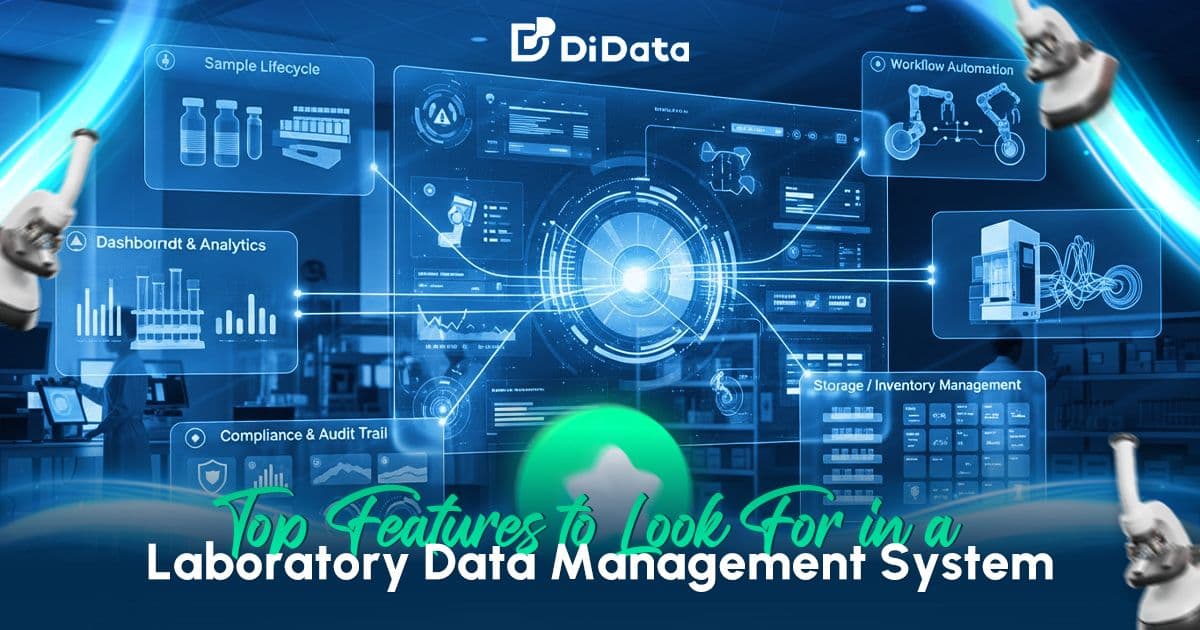
A modern Laboratory Data Management System must provide end-to-end sample lifecycle tracking, seamless instrument integration, and built-in regulatory compliance to replace outdated spreadsheets and fragmented tools. The most important features include workflow automation, robust audit trails, advanced data search capabilities, and scalable architecture that supports multi-site and high-throughput operations. Without these capabilities, a laboratory cannot ensure data integrity, efficiency, or regulatory readiness.
Introduction
In today’s fast-paced laboratory environment, where data volumes are growing rapidly, regulatory demands are becoming stricter and operational efficiency is a critical differentiator, choosing the right lab data management system is essential. Whether you're working in a biobank, clinical research organization (CRO), next-generation sequencing (NGS) lab, diagnostics facility or research institute, the system you pick will be foundational for sample management, data integrity, collaboration and compliance. This article explores the key features to look for, from workflow automation and instrument integration to robust audit trails and analytics, to help you evaluate your next investment strategically and with clarity.
1. Why a lab data management system matters
Before jumping into features, it’s helpful to understand what a laboratory data management system really means in practice. Historically, many laboratories used ad-hoc spreadsheets, paper logs or basic databases to track samples, results and storage. But as workflows became more complex, data volumes increased, and regulatory pressure intensified, these legacy approaches became inadequate and significantly increased the risk of errors . As one review states: The days of using bulky Excel spreadsheets are long gone.
A modern system (often called a Laboratory Information Management System or LIMS) provides a unified, secure, auditable environment and reduce errors, that supports:
- Sample and workflow tracking across the entire lifecycle
- Instrument and system integration (so data flows in automatically rather than via manual entry)
- Compliance with regulatory and quality standards
- Scalable architecture so that growth or new modalities don’t force forklift replacements
- Centralized Repository for data and inventory management
- User & Role-Based Access Control
- Reporting & Data Visualization
With that high-level view in mind, let’s dive into the specific features you should prioritise.
2. Core Features to Evaluate
Below is a breakdown of the key features to look for in a laboratory data management system, why each is important, and what to look out for when assessing systems.
2.1 Sample lifecycle & workflow management

The complexity of sample workflows is increasing: from collection, processing, storage, analysis, reporting and disposal. A system must handle this end-to-end without manual breakpoints.
What to check:
- Ability to register samples with unique identifiers (barcodes, 1D/2D) → reduces risk of mis-identification.
- Sample storage location tracking and retrieval (including cold storage, biobank inventories)
- Workflow or protocol management: the system should allow you to automate or standardise your process steps (e.g., sample receipt → accessioning → testing → result entry → storage/disposal)
- Scheduling and task assignment: e.g., automatically notify technicians of pending tasks, track turnaround time
- Visual mapping of storage (freezer racks, shelves) and ability to locate a sample quickly
2.2 Instrument and system integration
Manual data entry from instruments is a common source of error, inefficiency and inconsistency. Integration improves accuracy, speed, and ensures data flows directly into the system without human intervention.
What to check:
- Out-of-the-box connectors or API support to integrate analytical instruments, robotics, plate readers, sequencers
- Support for electronic laboratory notebooks (ELNs) or full instrument data capture (IDC)
- Ability to interface with external systems: ERP, HIS/LIS (for clinical labs), billing systems, analytics tools
- Real-time or near-real-time data capture and consolidation
- Backup or fallback capabilities if the instrument goes offline
2.3 Data management, search & retrieval

A modern lab accumulates vast volumes of data raw, processed, metadata, results, logs. Accessing the right data quickly is a core capability.
What to check:
- Centralised data repository (cloud or on-premises) with high availability
- Metadata tagging, custom fields, robust filtering and advanced search capabilities
- Version control or data lineage: ability to track changes, who did what and when
- Data archival and retrieval policies: how historical data is stored, searchable and retrievable
- High-performance search interfaces, dashboards for common queries (e.g., “show all samples processed during Q3 with status = pending”)
2.4 Compliance, audit trail & data integrity
Laboratories are often under regulatory scrutiny (ISO 17025, CAP, FDA 21 CFR Part 11, GxP etc.). A good system must support compliance, demonstrate traceability, maintain data integrity and secure sensitive information.
What to check:
- Audit trails that record who accessed/modified data, when and what change occurred
- Electronic signatures when required (e.g., result verification)
- Role-based access control (RBAC) with multi-factor authentication optionally (access can be assigned per project, per workflow or per dashboard)
- Data locking (once results are certified, they cannot be changed without trace)
- Encryption of data at rest and in transit, secure backups
- Compliance reporting functionalities (e.g., export logs for audits)
2.5 Workflow automation & configurable logic

To reduce manual tasks, improve consistency and speed throughput, automation of workflows is a major differentiator.
What to check:
- Drag-and-drop workflow builders (or equivalent) so you can customise flows without heavy IT overhead
- Pre-configured templates for common lab processes (sample receipt, testing, storage)
- Triggers and notifications (e.g., when a sample enters a queue, notify the next user)
- Automatic QC checks, thresholds and alerts (e.g., if instrument calibration is overdue or result out of expected range)
- Process monitoring dashboards that show bottlenecks, throughput, pending tasks
2.6 Scalability, performance & architecture
Your lab might be small today but could expand (new assays, more samples, multi-site operations). The system must grow with you and not become a bottleneck.
What to check:
- Hosting options: cloud, on-premises, hybrid – with clearly defined SLAs
- Multi-site or distributed deployment support (for global labs or satellite sites)
- Performance metrics: how many concurrent users, throughput of samples, latency for data retrieval
- Future-proof architecture: modular design, API-first approach, upgrade path without major downtime
- Vendor roadmap and support: how often updates are released, how backward-compatible they are
2.7 Collaboration, dashboards & analytics

Data itself is more valuable when it can be analysed, visualised and leveraged. Your system should enable collaboration across teams (R&D, QC, management) and deliver insights through dashboards.
What to check:
- Role-based dashboards: different stakeholders (scientist, lab manager, QA, operations) get tailored views
- Data visualisation: charts, trend lines, KPI tracking (e.g., sample turnaround time, QC deviations)
- Integration with analytics platforms (Power BI, Tableau) or built-in reporting modules
- Collaborative features: annotations, comments on records, shared dashboards, audit dashboards
- Export and sharing options: PDF reports, scheduled reports, real-time alerts
2.8 Inventory, storage, consumables & resource management

Many labs also need to manage not just samples but reagents, consumables, equipment calibration, storage space. A full lab data management system will encompass these aspects.
What to check:
- Inventory tracking for reagents, kits, consumables – with expiry dates, stock levels, reorder alerts
- Storage space management: freezers, racks, shelves – assignment of samples to physical locations and mapping of those locations
- Equipment and instrument calibration/maintenance tracking – automatic alerts when equipment is due for service
- Resource scheduling (e.g., booking of instruments, allocation of technicians)
2.9 Data archive, security & disaster recovery
Labs generate high-value data that must be retained (sometimes for many years). Ensuring its safety, accessibility and integrity over time is non-negotiable.
What to check:
- Regular automated backups, with defined retention policies
- Disaster recovery plan (off-site backup, fail-over, business continuity)
- Data encryption and secure archival formats
- Accessibility of archived data: ability to retrieve and restore promptly
- Compliance with data protection regulations (e.g., GDPR, HIPAA depending on region)
3. Prioritising Features Based on Your Segment
Not all laboratories have identical needs. Your priorities will depend on your segment . Here’s how you might tailor your feature ranking depending on your context:
By mapping your specific segment requirements, you can avoid the trap of being dazzled by features that may be nice-to-have but not essential for your use case.
4. Implementation & Change Management Considerations
Selecting the right system is just the first step. The success of a lab data management system implementation depends heavily on how it is adopted and integrated in your operational context. Some key strategic considerations:
- Stakeholder alignment: Ensure voices from all relevant groups (lab managers, technicians, IT, QA/Regulatory, operations) are involved in requirements gathering.
- Data migration: Legacy data (samples, historical results, storage location maps) often need to be migrated. Assess the vendor’s migration tools and support.
- Training plan: A user-friendly system still requires training, especially to ensure technicians use features like barcode scanning and workflow tasks correctly.
- Change management: Shifting from paper/spreadsheet to system-based processes will require change management, communication, pilot phases and iterative rollout.
- Vendor support & roadmap: Check the vendor’s support model, update frequency, flexibility for customisation, and whether upgrades will require downtime or data conversion.
- Validation & qualification: Especially in regulated labs (diagnostics, CROs), the system may need to be validated (IQ/OQ/PQ) and meet regulatory requirements.
- KPIs and ROI tracking: Establish baseline metrics (e.g., sample turnaround time, sample mis-identification rates, freeze-label errors) and track improvements after implementation.
5. Case in Point : Why These Features Matter
Let’s consider a practical scenario :
a mid-size NGS lab handling 10,000 samples per month. Without an integrated system, the lab uses spreadsheets to track samples, manual entry from sequencers, separate storage mapping in a standalone database, and ad-hoc QC checks. In this situation:
- Turnaround times are inconsistent, errors occur in sample tracking.
- Retrieval of a sample from storage is slow because the storage map is outdated.
- Results reporting is manual, causing delays to clients.
- Compliance documentation is fragmented, making audits stressful and expensive.
Now imagine the laboratory introduces a robust lab data management system with barcode tracking, instrument integration, workflow automation, dashboards and analytics. The benefits:
- Sample mis-identification drops significantly thanks to barcodes and automation.
- Technicians receive workflows automatically and tasks are tracked, improving throughput.
- Storage retrieval becomes nearly instantaneous because the system shows mapped locations in real time.
- Dashboards reveal bottlenecks (e.g., sequencing queue backlog), enabling the lab manager to allocate resources proactively.
- Audit trails and electronic signatures ensure regulatory compliance with minimal manual effort.
In this way, the features discussed above translate into tangible operational, quality and business benefits.
6. Summary : Building Your Evaluation Checklist
To help you in your procurement process, here is a condensed checklist you can use when evaluating potential systems for your organisation:
- Sample lifecycle & mapping: unique IDs, storage location tracking
- Instrument/ELN integration: API, automatic data capture
- Data management & search: metadata, filters, advanced query
- Compliance & audit trail: electronic signatures, access control, encryption
- Workflow automation: configurable workflows, triggers, notifications
- Scalability & architecture: cloud/on-prem, multi-site support, modularity
- Collaboration & analytics: dashboards, visualisation, sharing
- Inventory & resource management: reagents, equipment, consumables tracking
- Security & disaster recovery: backups, data retention, encryption, DR plan
- Implementation readiness: migration support, training, vendor roadmap
- ROI/KPIs: baseline metrics, projected improvements
7. Final Thoughts
In sum, adopting the right lab data management system is not just a matter of acquiring software, it’s a strategic investment in how your laboratory operates, scales and competes. By focusing on the features above and aligning them with your specific segment’s needs, you can avoid mis-steps and select a system that delivers measurable ROI: fewer errors, quicker turnaround, better compliance, more effective data usage.
FAQ
What is a Laboratory Data Management System?
A Laboratory Data Management System is a software platform designed to centralize sample tracking, workflow execution, data integrity, instrument integration, and regulatory compliance across laboratory operations. It replaces spreadsheets and manual processes with automated, auditable workflows.
Do all laboratory segments have the same feature requirements?
No. Biobanks prioritize storage mapping and long-term archiving, CROs need multi-site workflows and audit trails, NGS labs require high-throughput instrument integration, diagnostic labs focus on compliance and LIS/EMR interoperability, and research institutes emphasize collaboration and analytics.
How difficult is it to implement a new system?
Implementation success depends on stakeholder alignment, data migration readiness, training, change management, and vendor support. With proper onboarding, most labs become operational quickly and can validate the system for regulated environments.
What measurable improvements can a laboratory expect after adoption?
Typical improvements include reduced sample mis-identification, faster turnaround times, automated reporting, fewer bottlenecks, real-time visibility on workflows, and significant reduction of compliance risks.
Is the system scalable for growing or multi-site laboratories?
A well-architected system supports cloud or hybrid deployments, multi-site coordination, high data throughput, and modular expansion. It allows labs to scale without changing platforms.